The first takeoff engine is live: stormwater drainage, off the tender drawings
The first takeoff engine is live: stormwater drainage, off the tender drawings
We've been quiet about the Tender Portal while it was in build. It isn't in build any more. The first takeoff engine is finished and running: upload a tender set, and stormwater drainage comes back measured — pipes, pits, box culverts and headwalls, off the long sections, with every reach checked.
Here's what it does, what it doesn't, and what it costs.
It measures, and then it argues with the drawings
Any tool can add up pipe lengths. The part that takes an estimator years to learn is everything around the measurement: the crossing that will stop the excavator, the stub that isn't main-line production, the grade that doesn't reconcile with the levels either side of it.
That's the part we built. Every reach is run against more than 40 kinds of flag — 43 as at September 2026, and the list grows as the engine does. Among them:
Stubs and laterals, called out as separate setups rather than disappearing into the length of the main.
Splays, picked up on the reach they sit on, with CHECK ANGLE raised where no angle is drawn.
Single or multi-cell, pipe or box, how many barrels, and the width to carry where the drawing leaves it unsaid.
Size, class, joint and bedding, read from the general notes — and it tells you which note each one came from.
Levels that don't add up: uphill falls, grades under the stated minimum, inverts above the surface, drops and lengths that fail to reconcile.
Bracketed second levels, where the deeper barrel is the one that digs the trench.
Plan sheets misread as long sections. A datum check refuses them. On one real set, that removed six reaches that didn't exist.
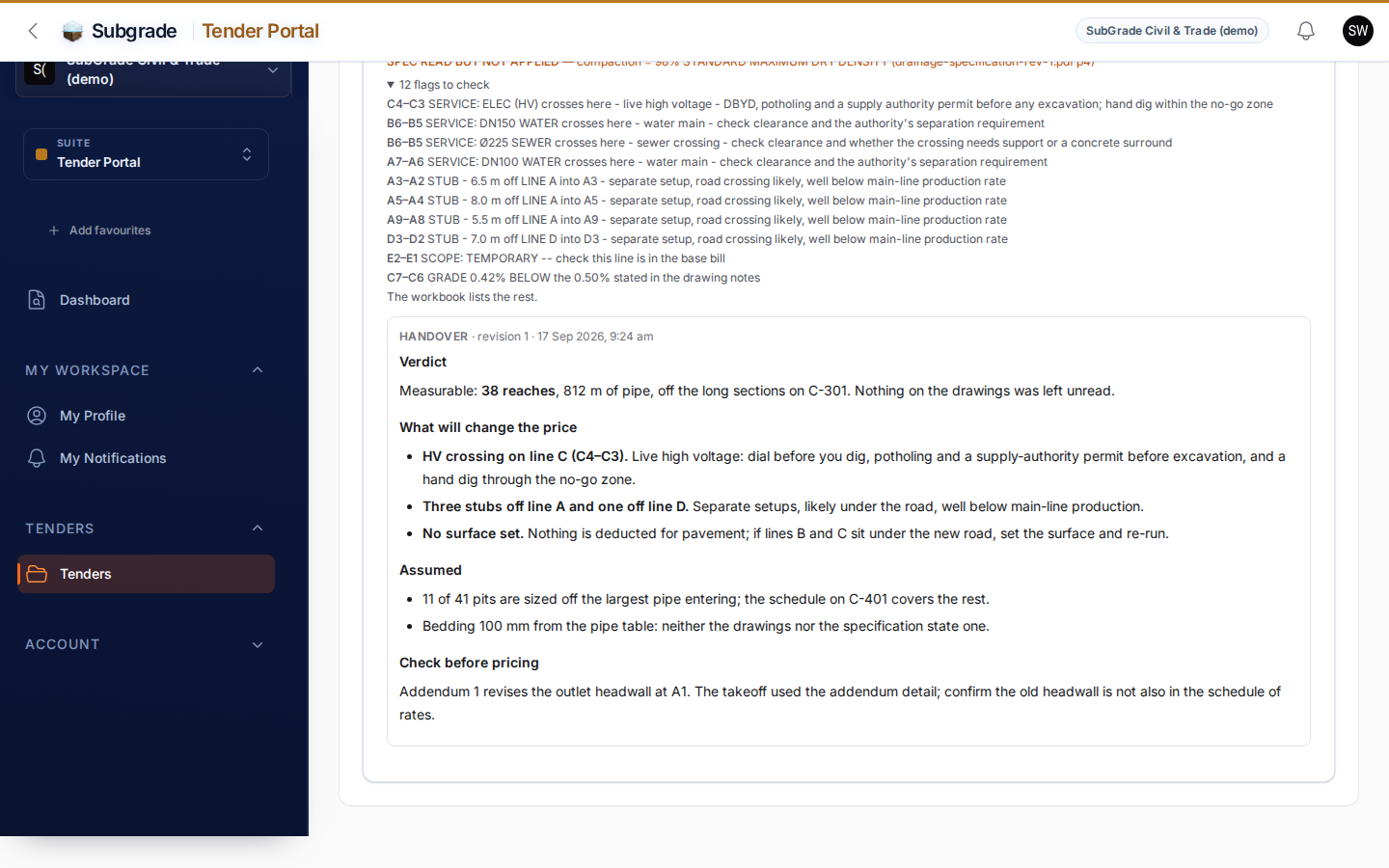
Pits and the job as a whole get their own checks: pits with no depth, pits deeper than their type allows, pit sizes assumed rather than scheduled, a surface never established, a specification read but not applied, and a completeness audit that names any sheet which produced nothing.
The point isn't that the engine knows things you don't. It's that it runs the same checks on the seventh reach of a Friday afternoon as it did on the first one Monday morning.
Every service crossing, and what it will do to your production
This is the one we're proudest of, because it's the one that costs money on site and never appears in a quantity.
The engine finds every service crossing a reach passes through and flags it twice. First with the precaution for that particular service — a high-voltage crossing says dial before you dig, potholing, and a supply-authority permit before anyone opens the ground. Then with what that crossing does to the dig, worded by risk:
High risk — high-voltage and low-voltage electrical, gas. Excavation at the crossing runs well below main-line production rate: the excavator stops, the asset is located by potholing, and the ground through its clearance zone is dug by hand.
Medium risk — sewer, water, comms, and anything crossing that can't be identified. Excavation runs below main-line production rate: the asset is located and the trench taken past it with care, supported or protected while it's open.
Low risk — irrigation. Excavation runs slightly below main-line production rate: the line is located and capped, protected or reinstated at the crossing.
And it totals them for the job. On one real set: 53 crossings on 45 reaches — 15 high risk, 38 medium. That's 45 reaches where your excavator is not going to run at the rate your schedule assumes.
To be precise about what that is and isn't: the engine does not apply a production factor, a rate or a duration. No document it reads states one, so inventing one would be making it up. What it does is put every crossing, its precaution and its production impact in front of you before you price the job, instead of after you've won it. The allowance is yours to make. Stubs and laterals are flagged the same way, for the same reason.
The specification decides, not us
Measurement basis is where drainage quantities are won and lost. Two estimators measuring the same trench to different specifications can be 20% apart before either has made a mistake. So the engine doesn't have a house rule. You choose the basis the contract is actually on, and it measures to that.
State road authorities
NSW — TfNSW R11, and separately the R11 measured pay width that a Construct Only schedule actually pays excavation on. Narrower than the template at every size.
VIC — DTP Section 701 at 300 mm each side, or 600 mm where a mechanical compactor works the side zones (SD1511 Table 1).
TAS — State Growth Section 701.
QLD — TMR SD1359 minimum trench under MRTS04 / MRS04, 300 to 700 mm each side by pipe size.
WA — Main Roads Specification 404 and SD0062, where the trench follows what sits above it: under road, cement-stabilised backfill over the pipe; elsewhere, no CSB and a narrower clearance.
NT — DLI Roadworks, CS3101 margins, measured to invert with bedding in the rate.
ACT — TRITS 03 and the ACT-edited R11 pay width, for trunk and arterial roads.
Council and subdivision
AUS-SPEC 1351 pay width — 1.4 × OD, or OD + 300 mm each side, whichever is greater, to the underside of the specified bedding.
The drawing-note basis — the "TRENCH WIDTH = O.D. + 300 MIN" note that turns up on council standard drawings.
Special cases
CLSM (flowable fill) — flowable fill needs no compaction plant, so the trench narrows.
Manufacturer minimum — the narrowest trench the pipe can physically be laid in. A floor, not a working width.
Every basis carries two things beside it: how far we've verified it, and what you should check it against. The AUS-SPEC one tells you councils amend AUS-SPEC in brown text and the pay annexure is optional on private development. The CLSM one is marked unverified, in those words, because it is. We'd rather tell you where to look than let you find out at claim time.
South Australia is the one gap, and it's being built. No date on it.
You get quantities, not a price. The output is a drainage workbook with live formulas, so your rates stay yours. The workbook recalculates itself and is refused if it disagrees with the takeoff — we'd rather hand you nothing than a spreadsheet that quietly disagrees with its own numbers.
No long sections? You still get a takeoff
Most tools refuse a set drawn on plans alone. This one measures it off the plan scale and says exactly what that costs you: no depth, lower accuracy, and its own flags for anything it had to carry or couldn't confirm. Not as good as a set with long sections. A long way better than nothing when the tender closes Thursday.
Speed, honestly
A takeoff comes back in about a minute. The biggest sets we've tested took under three, triage included. Page count doesn't decide it — how the set is drawn does.
On accuracy the sample is still small, so here it is plainly: on one set the engine read 4,079 m of pipe against 4,082 m measured by hand, with excavation within half a percent. On another, every reach length matched to within 50 mm. That's on the sets we tested. Yours may differ, and the flags exist precisely because some of them will.
What still belongs to you
Plenty, and we're not pretending otherwise. You say what sits above each trench — road, footpath, verge, open ground — though it's pre-filled where the pit types settle it. You choose the measurement basis and contract type. You work the flags and confirm assumed pit sizes. You handle what's listed but not measured: reinforcement outside headwall tables, formwork, dewatering, traffic control, service protection. And you price it.
What changes is where your hours go. Not measuring for a day, then checking for an hour. Checking for an hour.
This is Phase 1
Drainage is the first takeoff, not the last. It went first because it's the one where the detail punishes you: levels, depth bands, services, pit types, and a different pay width in every jurisdiction. Get that one right and the rest follow.
The next takeoffs are in build. No dates on them.
Here's where it's heading, though, because it changes what the whole thing is for. Today a takeoff hands you quantities and you price them. Once the full set of takeoffs exists, they'll feed straight into the rate manager in your Civil Suite — the same labour, plant and supplier rates you already run jobs on. Drawings in, quantities measured, your own rates applied, a priced tender out the other end, with every number still traceable back to the drawing it came from. And the job you win arrives in the suite that runs it.
That's the destination. Phase 1 is on the ground and working today, and the quantities it produces are worth having on their own.
What it costs
The Tender Portal is $10 a month, and takeoffs run on credits.
A full takeoff is 25 credits, quoted before the run so nothing is spent by surprise.
The plan includes 10 credits a month.
Every new workspace gets a one-off 25-credit welcome bonus — your first takeoff, on us.
Top-ups: 25 credits for $25, 100 for $89 (11% less per credit), 250 for $199 (20% less). Credits you buy never expire.
While we were at it: the rest of the pricing
Subgrade is three suites on one login and one bill, and the pricing now says so plainly.
Civil Suite, from $149 a month: timesheets, prestarts, crews, payroll, job cost, safety and training.
Trade Pack, $29 a month: work orders, dispatch, invoicing and receivables. Take it on its own, or add it to a Civil plan for $29 on the seats you already pay for.
Tender Portal, $10 a month, or included from Small Crew up — 10 credits a month on Small Crew, 25 on Contractor, 50 on Civil Group. On plans below that, add it for $10.
A paid seat is a person, not a suite: one seat reaches every suite your workspace has turned on, and your team, roles and billing stay in one place. Prices are in AUD, monthly, excluding GST. Every plan, add-on and credit pack is now listed on one page, with a page per suite behind it.
Try it on a real set
The most useful thing you can do is give it a tender you've already priced by hand, and see where it disagrees with you. That's a 25-credit exercise, and your first 25 credits are free.